Proceed with Caution

Before we liberals get carried away with jubilation over having seen Mr. Trump get his pie in the face over Obamacare, let’s remember that the people most responsible for his embarrassment are the very people with whom we most deeply disagree on almost every political issue of the day — the Freedom Caucus. That group of three dozen or so House members consists of the remaining dregs of the Tea Party, now marooned at the bottom of the cup by the dog and pony act now playing the White House. The caucus proclaims fidelity to most of the worst goals of the post-Reagan Republican world : from trickle-down economics and Grover Norquist’s “no more taxes” to the use of fetuses and refugees as partisan weapons. It is highly unlikely that we can form any lasting alliance with such people, and therefore equally unlikely that we can count on any such lucky rescue when the next obnoxious Trump proposal comes along.

Will that be immigration? Ecological suicide? Control of the Internet? Exclusion of people whose religions or skin color or birthplace will serve as reason enough to throw them out of our country — or maybe throw them in the slammer with Crooked Hillary? Trump’s clown advisors will have to decide.

Whatever it is, we can anticipate that even the catch-as-catch-can improv crew currently serving as advisors to the Oval Office are unlikely to fall twice in a row into the same trap. They may be nefarious or not, according to your personal view, but they didn’t get where they are by being totally stupid. They have shown imagination, at least in the matter of persuading a sufficient number of not very logical citizens to behave in self-destructive ways under the spell of meaningless slogans and chants and bombast and a bouffant hairdo. This, as much as we may bemoan it, has demonstrated their political skill, and we can expect that skill to be deployed vigorously down the line since as troglodytes and Luddites Trumpians can’t rely on substance. So we will have to be prepared to mount the next defense based on our own resources, and not rely on the continued disorganization or miscalculation of our opponents.

How do we do that?

My suggestion is that, like a Breitbart editor with a bit of catnip alt-right misinformation, we wave it before the troops to the bitter end — never stop alluding to it, never stop digging it up on every suitable or unsuitable occasion, and never, never let allow even the most trivial bit of fake news to be relegated to yesterday’s headlines, where it can be buried under a flood of new provocative allegations. The telephone-tapping accusation must be pursued : where is the evidence? The Russian connection must be investigated : where are the emails? The tax returns must be disclosed : how long can the IRS be permitted to continue its audit? Rejection of climate science must be challenged in every smallest detail : the most revered names must sign the declarations. The roles of the arts in society must be examined with all the intensity that the F-35 contract received. The fight over eliminating mountain-topping and valley-choking in West Virginia must stay front and center until the citizens of Wyoming understand that it does indeed matter to them and to all the rest of us, from Mississippi to Maine.

This will come across to many, whose worst fears went unrealized last week when Obamacare survived by the skin of its teeth, as unnecessary preoccupation with vengeance after the horse has been found and coaxed back into the barn. It is not. It is the everyday price of decent government. Persistence is far more effective than brains in a town where election to the House guarantees a 97 percent shot at being re-elected forever. (Even Senators enjoy 87 percent odds of a return to office.) By limiting our off-and-on personal involvement to those occasions when the Times breaks out the 30-point caps on the front page, we insure that the inside stories about “minor” transgressions can be lived down by the crooks. The broken windows approach to street crime may be an overreach; but when applied to politics it is the only approach that has any hope of successfully penetrating the closed-door sessions of blatantly competitive and self-serving politicians, who seek only cover for their personal ambitions and their invitations to the A-list events so prized by their wives (or their husbands, as the case may be) and their post-government-career connections to the plutocrats with the moneybags and the sinecure appointments to corporate boards. Fighting the status quo is the price of good citizenship.

Will we take that lesson to heart? I wouldn’t bet a whole lot of money on it. I suspect we are far more likely to subscribe to the comforting illusion that “We are all Kardashians if only the TV producers would spot us.” That lucky stool at the soda fountain in the Hollywood of 80 years ago may be myth, but it’s reincarnation is only as far away as the next push of the remote button.

← Back

Thank you for your response. ✨


← Back

Thank you for your response. ✨


The Law of Jante

In 1946, out of the army, out of a job, angry at the indifference of the job market with its inhumane “acceptable level of unemployment”, out of optimism, and scared for my starter family, I read a book about Sweden by a man named Marquis Childs called The Middle Way. He had written (in 1936) that Sweden had charted a political course, partway between capitalism and socialism, that seemed to offer promise. It had built on a labor-union-based political party and a strong co-op movement an extraordinary voting majority for a variety of social support programs. There were extremely high taxes, true, but the combination was said to have created a socially relaxed society in which citizens appeared to feel empowered, confident and secure; in short, a better system than the one I was enmeshed in.
The judgment of the world’s establishment economists was pretty nearly unanimous in pointing out to Mr. Childs, (patronizingly, he was after all just a newspaperman, not an accredited Wharton School graduate) that a full nanny state that set out to care for its citizens from cradle to grave (including child care for working parents, free education, free health care, guaranteed pensions and free state-run assisted living retirement homes), even combined with income taxes in the 50 percent range, could not possibly survive more than two or three years of dramatically unbalanced budgets, stifling bureaucratic inefficiency, and taxpayer revolt by the entrepreneur-minded, who would flee to other countries (in a so-called “brain drain”), taking their money and their talents and the future of the country with them. The economy would inevitably have to collapse, paving the way for a populist demagogue would seduce the ignorant with his empty promises and relegate Sweden to the historical ash heap of the third world. I decided to go see for myself.

Well, it is now 70 years on, and the world (both first and third), and I have all so far managed to survive, and today I got an e-mail from my 25-year-old granddaughter who lives in Stockholm quite comfortably in a government-subsidized apartment on a government-provided student stipend, with four more years of studying in prospect before she gets her degree in robotics engineering. (This was actually her second choice, after an initial try at a musical career, where she played in the government subsidized National Youth Orchestra. She said she eventually realized that she was not talented enough on her violin to rise to the ranks of soloist, and that “second fiddle” would not satisfy her. She had no problem with the education bureaucracy about changing her majors.)
The e-mail was mainly family news, but in answer to some of my questions she said that Sweden was doing just fine, thank you, with one of the strongest economies in Europe and a population that, when polled, declares itself among the happiest in the world.

For those of you who like to see the actual numbers I will give them to you. She provided links to several databases. In 2016 Sweden’s national debt was 43.4% of its GNP. (For the USA it was 104%, more than twice as high.) Meanwhile Sweden’s flourishing economy has enabled it to become one of the most generous nations in the world toward today’s nearly 17 million political refugees (who are, as we all know, “guaranteed” by the UN’s 1951 International Refugee Convention the same rights and privileges as any foreigner who is a legal resident of the country in which they have sought asylum). With a population of 9.6 million, Swedes have so far accepted 111 thousand refugees (equivalent to just over one percent of their country’s population — one refugee for every 86 Swedes). Germany, by way of comparison, with 50.6 million people, has accepted 800 thousand (almost exactly one percent of its population — one asylum seeker for every 101 Germans, a number which is threatening the stability of Angela Merkel’s government and its leading position in the EU). The corresponding numbers for my country, which embarrass me even as I type them, are 85 thousand refugees accepted into a country of 319 million, or one for every 3,753 Americans (that’s two hundredths of one percent of our inhabitants), and nearly half of us presently appear to be willing to throw them out again and lock up the lady who struggled to negotiate their humanitarian acceptance in the first place.

So much for the accepted wisdom of 70 years ago and the realities of today, and if you bring up the subject with mainstream economists of 2017 you are likely to hear the same dire predictions that Childs’s report elicited in 1936. “It’s only a matter of the timing. Look at the key numbers. People won’t stand to have their ambitions forever stifled under socialistic central direction, over-regulation, and sky-high taxes.” The Wharton School, so far as I know, like the Swedish economy, goes right on teaching the same lessons, taught by the same expert professors.

My granddaughter recently replied to one of my requests for further information with a link to a newspaper article about Stockholm being today one of the most entrepreneurial cities in the world, rivaling Silicon Valley in the number and variety of its startups. Over the past 10 years Sweden has seen the infusion of one of the highest levels of venture capitalism in Europe. My granddaughter’s student friends, she says, are, like her, excited about new scientific developments that may lead to new enterprises, and they relish the excitement of being in on the ground floor. They pull all-nighters on their computers in their dorms at the KTH (Kungliga Tekniska Högskålan) just as assiduously as their coevals at Stanford, and with the same goal of being the first to spot the next big new thing.
How do you account for that, I ask?
My granddaughter shrugs with an interpolated emoji and says maybe it’s just the Law of Jante.

The Law of Jante was a new one for me. I had never heard of it. Try it out for yourself though on anyone from a Scandinavian country and you will find that it is a commonly understood and accepted socio-economic concept. Jante is a fictional town in a fictional country in a novel written by a Danish author named Aksel Sandemose in 1933. In this town the mark of greatest possible accomplishment is to stay under the radar. To be at peace with your neighbors and with yourself is considered best achieved by keeping a low profile. The welfare of the community is always to take precedence over individual accomplishment. In fact, individual accomplishment is best kept concealed to avoid embarrassing anyone who may not have achieved as much as you have. The spotlight is to be avoided, since it can prove addictive, to the detriment of community solidarity. This is summed up in Jante by a law consisting of ten rather redundant commandments by which the inhabitants of the town live, the first of which is probably enough to convey their tenor — “You are not to think you are anything special.” Some of the other nine are equally blunt: “You are not to think you are smarter than we are.” “You are not to think you know more than we do.”

You get the picture. A Donald Trump would be run out of Jante instanter. A Jante citizen who got his name in the paper would feel ashamed unless it were coupled to an account of his selfless contribution to the society’s improvement. A fat bank account or a large lawn would of itself be convincing evidence of its possessor’s lack of real understanding of citizenship and his adherence to Jante law.
That law may not be considered a worthy goal by every Nordic citizen, but it is generally accepted among Scandinavians as a legitimate aspiration, says my granddaughter, and one that might, coupled with the right conditions in the rest of the world, be a worthy basis for our mutual future progress. In retrospect in fact, Sweden’s development over the past 100 years or so (since the Social Democrats first started to routinely win elections) can be seen as heavily influenced by the until then still unformulated Law of Jante.
The name of Sandemose’s book is A Fugitive Crosses His Tracks and there was an English translation published in 1936. I will not be a spoiler for any of you who might want to track down a copy and see what happens.

What I find fascinating is the apparent unquestioning acceptance in today’s U.S. by followers of The Donald that exactly the opposite of Jante’s law is the ideal to which all we Americans should strive. If The Donald has gold faucets in his tower then we are supposed to ooh and aah and admire and fantasize that someday each of us might be able to enjoy the same kind of bling. So much are we bedazzled that we have entrusted the next four years of our country’s future to his care.
Numbers and facts mean nothing in the face of the prospect of gold faucets in our bathrooms. A chicken in every pot. Father Divine reincarnated in a white skin. Remember the Reverend Ike — Fred Eikerenkoetter II — “God wants you to be rich.?” Not Marx’s “From each according to his ability, to each according to his needs,” but “Everyone into his own Trump Tower”. And Katie, bar the door.

I could go on about Marxism and economic exploitation and the Frankfurt School , but I will give you a break — and give the last word to my granddaughter: She writes, “Trump is ridiculous. How long before he’s gone?”

← Back

Thank you for your response. ✨


trump tactics

Once upon a time a sports reporter named Howard Cosell got good mileage out of the slogan : “Tell it like it is.” Now Donald Trump has appropriated it, with a slight change : “Tell it like it isn’t.” Cosell’s message was about telling truth to power: standing up for Mohammed Ali against the establishment. Trump’s message would seem to be more like the opposite : annihilating truth with power. Other than the future trivia question engendered by their respective hairdos, there would seem to be no place where the two men could agree except that they both seem to be recommending confrontation as a strategy for dealing with what each perceived as a social problem. Cosell was crusading on behalf of his friend who was being persecuted for his anti-war beliefs. Trump seems just to be crusading on behalf of himself: Donald Trump, whose “gigantic brain” and “genius” apparently need daily if not hourly reinforcement by generous doses of sycophancy, hyperbole, exaggeration, and falsehood. Cosell was eventually vindicated by the realization of the American public that depriving Ali of a title he had won fair and square in the ring was unfair. (To use one of Mr.Trump’s favorite debating points : “WRONG WRONG WRONG”.) Mr. Trump seems to believe that his vindication will come when America is made over into a fusion of Putin’s Russia and Hitler’s Germany, where the winner will be the person with the loudest voice and who identifies the most “other” groups to blame his problems on, and who can assemble the most ignorant oligarchy to be his henchmen and who can most effectively stifle the press.

Ali’s reputation was eventually revived by the public’s realization that his “I ain’t got nothing against them Congs” was more honest than what our military-industrial complex was telling us. What hope do we have for the Trump problem? The gradually dawning revelation of his mental instability will come more quickly now that he has acquired a signing pen. (Have you taken note of the “yuge” nib? It’s as big as his opinion of his whatever.) The problem, as it was in Nam, is that the realization will come slowly. The injustices to Muslims and Syrian refugees don’t immediately affect the average American voter. It will take 20% increase in Walmart’s and Honda’s prices, and a painstaking education campaign about why they went up, to awaken us. By that time he will have been able to inflict all sorts of damage to the fights against carbon emissions, global warming, deforestation, mountain top removal, the public education system, the laws protecting LGBTQ rights, the makeup of the Supreme Court, voter registration laws, affordable health care, Social Security and the billionaire-favoring tax code. Among other things. Unless we choose to intervene.

“At long last, sir, have you no decency?” Joseph Welch finally asked Joe McCarthy three-quarters of a century ago, and the country finally recognized that plain outright lying was not acceptable in politics. We kicked out McCarthy and his buddy Roy Cohn in time and the nation survived. McCarthy’s “others” — Communist Fifth Column plants behind every desk in Washington — were as phony as Trump’s terrorists swelling the ranks of incoming refugees and his Mexican rapists driving up the crime statistics in Chicago. But it was, as those of us who were here in 1954 remember, a near thing. It almost tore the country apart. That “almost” is the key. That it didn’t was due to the strength of our belief in a free press, democratic government, and the moral importance of justice. That belief is now faced with a new test in the person of someone who is a certifiable sufferer from Narcissistic Personality Disease whom we have unaccountably elevated to the Presidency.

How that happened, or how broadly the cloak of collective responsibility should spread, is no longer material except as a lesson for future political strategists and historians. The immediate problem has now become one of (a) recognition of our mistake, and (b) finding effective tactics to atone for it and remove its threat to the stability of our government. (And very possibly not only ours. We are the exemplars to the world. At this moment a laughing stock.)

The first step — recognition of the problem — is under way. As the reckless and unhinged reactions of the patient are codified and assembled under the boldly aggressive signature so eagerly displayed by its author to any camera in the vicinity, citizens are already reacting. They march in support of the persecuted, chant in support of the rule of law, write and call their congresspeople to plead for a return to sanity. Those congresspeople, some torn between what they perceive as a chance for personal career enhancement through sycophancy and the dawning realization that this will in the end destroy their personal estimation of themselves, are struggling with the problem.

My hope is that the more they see of the America Donald Trump has in mind for them the more their eyes will be opened, and the sooner they will support his eventual impeachment.

For impeachment, I believe, is inevitable. Somewhere there is a Joseph Welch who will ask the right question at the right time and wake us all up. After that it will become just a matter of working out the details — who will take the lead in calling the would-be Emperor’s bluff, who will start with the actual steps of defining an indictment (probably based on the best word the Constitution offers us for salvation : “misdemeanors”), and organizing the Senate trial.

Trump’s exile will not end the divisions between the establishment haves and the self-perceived disrespected have-nots in our country, but the experience will have warned us against the dangers posed by quick-fix con men. How seriously Messrs Pence, McConnell, Ryan, et al. will take this lesson to heart will be the next critical issue. We and they will have to discuss it and take whatever steps we feel are necessary to avoid a repeat performance. It will not be a fun time, but I have faith that Americans, red or blue, brown or white, vengeful or thoughtful, will get more satisfaction from trying to solve the problem than from trying to exact satisfaction for past wrongs. As human beings we tend to believe in forgiveness. We are usually happier to save a soul than to condemn one to eternal torment. We are not against wealth; we just would like to see it spread more equitably. We don’t hate individual Syrians or Muslims or Mexicans or Jews; we can only hate them collectively, as “the other”, seen as responsible for our unemployment, poverty, helplessness and frustration in the face of terrorism, and (we may think) actually eradicable so that Heaven on earth can be realized under the auspices of the smart, white, high-school educated, religious, past-worshippers who today seem to be forgetting that this country was founded as a haven for dissenters, not as a haven for tax-evaders.

This vision is perhaps as hard to believe in as Donald Trump’s illusions of crowd sizes or the zillions of his worldwide adoring admirers, but it is not to be dismissed as crazy. It is to be accepted, even by those who don’t subscribe to it, as an inevitable reaction to disappointment and alienation, which can only be dealt with by education and love. Yes, love. If you don’t love your fellow man whom then will you love? The high radiation-tolerant rats ready to take over the next experiment in running the planet?

So what’s my advice? Dig in for the long haul. It’s a battle that can be won. Trump can be defeated. Washington can be reshaped from a political cut-throat career cauldron back to a representative deliberative body. The table can be made round again so we can all sit at it together — nobody below the salt. The UN is salvageable. The story of the Donald may be the reinforcing lesson we all need to remind us that the price of democratic government is constant vigilance.

← Back

Thank you for your response. ✨


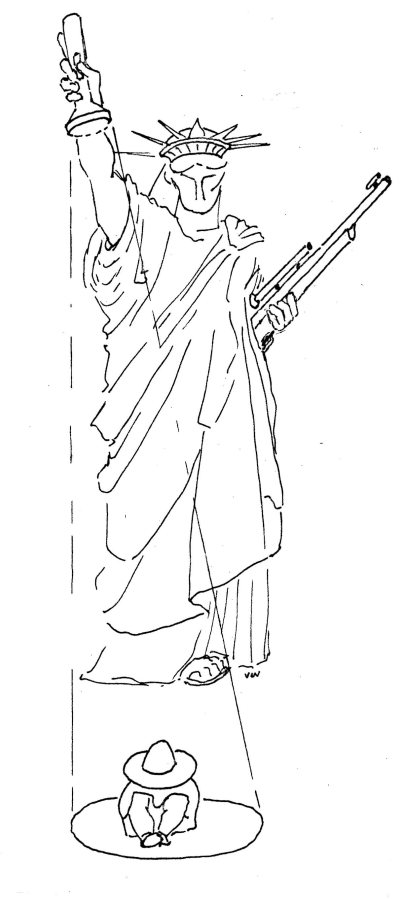
lady liberty


EPSON scanner imageGive me your

tired, your poor,

your huddled

masses yearning

to breathe free,

the wretched

refuse of your

teeming shore.

Send these, the

homeless,

tempest-tost, to me.

 I lift my lamp beside the golden door.

Me talkin’

This is Me, y’all, so put away your toys and listen up. Right now I am an unhappy camper, and you know from experience that can be a problem for you. Ask Noah. Or Old Pharaoh. Remember them frogs and the locusts? So listen up when I say listen up if you know what’s good for you.

Some folks say y’all created me in y’all’s image. Other folks say the other way ’round : that I created y’all in my image. I can’t say about that. I have no idea what was here before I came, if there was a “here” before I came, so how could I know? But when it comes to this business of image, whoever’s it was to start with, we have now come to share pretty much the same one, and that’s what’s concerning me today. That it’s the same one. If either of us — y’all or me —  does something to tarnish that image, we are damaging something that’s common to both of us, and I don’t feature having my image tarnished by y’all’s mistakes, if you get my meaning. So we’re going to have to get some things straight.

Over the years I have sent you word from time to time about how I want you to behave. Start with Moses. He was my main man back then. But even before Moses. I read somewhere that the old Jews had to perform 613 different mitzvahs to be on the safe side — to be considered good people when the Judgment Day came. I don’t know where they got that many. Not from me. No way I could dream up that many. I have always said that there is only one thing you need to remember to be a good person — just treat everyone like you would like to be treated. But some prophets have staked out their turfs with different rules. Would you believe that when Moses originally came up the mountain he had a list of more than 100 things he wanted to put on those tablets? All kinds of stuff about what to eat, what not to eat, when to pray, which way to face — I mean it was a real meshuggenah mess.. I told him, Moishe, there’s no way you’re going to fit all that on those two little tombstones. Boil it down.

Well, it took a while, but we finally worked the hundred down to just ten. Unfortunately even ten turned out to be too much for some folks. They kept finding loopholes. Some wanted to go back to the original 613. I sent them word by way of several Popes and rabbis to help them sort things out, but the new prophets turned out to be as stubborn as Moses and I was busy with other things. I tried again later with a fellow named Muhammed. Had him up here for a nice visit and we reworked some of the biggest problems. We got it down to five major commandments and about a hundred nitpicks — he called them suras. But then I discovered that he had started making up new suras on his own to deal with some of his personal problems — like the four wives bit. I tried to persuade him that the Five Pillars would be all he needed, but he insisted, so I let him keep them both as long as they didn’t contradict each other too much.

As far as the story with the Popes goes, that fellow with his 95 theses pretty much nailed it five hundred years ago. He was so right and they were so wrong that they finally had to throw him out of the church altogether. They got the throwing part right, we had precedents for that with the money lenders in the old days, but it was supposed to be the bankers who got thrown out, not Luther. The popes didn’t see it that way. Well, Luther’s people went back and resurrected Moses’s original ten, and we pretty much wound up back where we started.

And now we’ve got some new of self-anointed prophets. The most straight-laced and uncompromising so far. No use for thinking at all. Just do what we say. No questions. Seems as though they’ve got it all boiled down to one method for dealing with questions — you might call it the Queen of Hearts method — “Off with their heads!”

So I’m going to say this one more time : All you need is “Do unto others…”. All this other stuff about skin color, the shapes of noses, who was your grandfather, who were the original natives and who were the invaders, promises I am said to have made, brains I am said to have handed out unequally, the hereditary rights of kings, the sanctity of private property — all that stuff is diversionary garbage. Just “Do unto other as you would have them do unto you” and that’s it. You don’t need anything else.

You want to see those locusts again? More fiery hail? Boils? Lice? I know how to do all those tricks, and I can also do volcanoes and earthquakes if you provoke me. Three days of darkness was just a taste but as I recall it really got your attention. So listen up. And shape up. The end may be nearer than you think.

This is Me talking, so pay attention. you hear?.

← Back

Thank you for your response. ✨


Now What?

We now have all the evidence we need that Donald Trump is a sick man, relishing the display of his TV celebrity status above any concern with (or understanding for) governing the country whose laws and Constitution he has recently sworn to defend. This is frightening, amusing, thrilling, or rewarding, depending on where your sympathies lie. The newspapers and magazines and TV screens and the blogosphere will be all about one topic for the foreseeable future. With any kind of good luck, though, increasing exposure will slowly have its effect, and even the presently thrilled will come to understand that here is a man whose limitless love affair with himself has the potential to wreak serious damage on our country. We now know for sure that Trump has got to go. The question is no longer whether, but how.

There would seem to be three possibilities. One, he is declared by competent medical authorities to be afflicted with Narcissistic Personality Disorder, a malady formally recognized by the medical establishment (in The Diagnostic and Statistical Manual of Mental Disorders, (AKA the DSM), fifth edition, published by the American Psychiatric Association in 2013). His symptoms are a perfect fit, and such a person is by definition disqualified to be in charge of any important matter not directly concerned with his own worship of himself. I would think this would apply to being the President of the United States. A formal diagnosis of DSM would allow the triggering of the set of procedures set forth under the 25th Amendment to our Constitution, to wit : Whenever the Vice President and a majority of either the principal officers of the executive departments [the Cabinet] or other such body as Congress may by law provide…transmit to the President pro tempore of the Senate and the Speaker of the House of Representatives their written declaration that the president is unable to discharge the powers and duties of his office…). What then follows are the impeachment preparations we all grew familiar with not too long ago in the cases of Richard Nixon and Bill Clinton.

The second possibility is that some of his obvious transgressions, such as issuing orders without consulting the heads of the government departments tasked with forming and enforcing them, appointing members of his family or cronies whose conflicts of interest are glaringly apparent to advisory positions, or infringing on the rights of citizens on the basis of their ethnicity, could well be taken to conform to the definition of the term “misdemeanors” as specified in Article Two, Section 4 of that Constitution. (There are also the questions of whether his duties may border on the issue of bribery, in view of his commercial ties — according to the so-called “emoluments” clause — should count, and whether his admitted addiction to grabbing women by their pussies, though obviously a civil misdemeanor, should also count, since at least so far as we know they have been discontinued since he took office.) “High crimes and misdemeanors” are also Constitutional grounds for impeachment, although “high crime” is better defined (treason, for example, and bribery) than “misdemeanors”.

The third possibility is that the long-awaited disclosure of his tax returns shows that he has been engaging in illegal activity throughout his long-running streak of failed businesses and bankruptcies, only a portion of which involves failure to pay his taxes. (He is currently involved in 75 actively ongoing lawsuits, brought either by him or against him, for various alleged illegalities. He is an inveterate litigator, having been involved in at least 4,000 lawsuits during his business career — incidentally putting a severe strain on the court system that he refuses to support with his taxes.) This makes it possible that he could somewhere along the line become a convicted felon and thus be disqualified permanently from federal office. Exactly how such a development would be handled by his new Attorney General is not clear.

Unfortunately the first two cases would require the votes of two thirds of the House of Representatives, a possibility that seems remote given its current makeup of career-seeking cookie-jar-raiders and Tea Party nuts. Sycophancy is an addictive drug, especially when the bully in chief is notorious for agreeing with the last person who has emerged from his bear hug.

This leaves non-Trumpists with no obvious course except civil disobedience, which, if performed judiciously, can be accompanied by almost indefinite delays while the courts try to clear their backlogs. Those delays can be accompanied by obstructionist motions and stays of execution, and if dragged out long enough, can result in eventual victory by stalling. Ask your friend who is a partner in a white-shoe law firm for advice about this. It’s a law school specialty, I’m told.

There are signs that we have already begun to act on this. The Women’s March after the swearing-in ceremonies in January turned out ten times Trump’s inauguration crowd, which seriously got his goat. More marches and demonstrations are being scheduled for the coming weeks and months. Acting Attorney General Sally Yates has been fired for doing her part. GoFundMe came up with over a million dollars within 24 hours following the mosque fire in Texas. Thousands of State Department employees have signed a letter of protest against reckless foreign policy edicts issued from the White House with no advance consultation. The actions of the Department of Homeland Security at international airports everywhere in the country now bring flash crowds of protesters. “Build that wall!” has been pretty much discredited except by chicken-hearted NFL Super Bowl TV advertisers, and Hillary does not seem to be in danger of going to jail anytime soon. Some of the wilder promises from the campaign are being quietly swept under the rug. (Remember “We can just take their oil”?) Millions of people now keep the Capitol switchboard’s number on their cell phones (202 225-3121, in case you have forgotten Michael Moore’s mantra), and if their calls go through (mine so far haven’t) the messages to specific lawmakers are not very likely to be pro-Trump. Whether a sufficient number of legislative spines can be stiffened by such a barrage remains to be seen.

(My humble suggestion is that distribution centers be set up, maybe supported by GoFundMe, to hand out pink pussy hats for the ladies and tangerine-colored toupees for the gentlemen so that whenever Trump is confronted by a crowd he will be reminded that he is scorned by a “yuge” majority of his citizens. This, according to the above-cited manual on mental disorders, might well provoke such confusion that it could become self-destructive. The shrinks say he could be moved to resign in a sudden huff or even suffer an apoplectic seizure, but this is probably not a good bet. If shrinks are our last hope we are really in trouble.)

Realistically, concerted foot-dragging and organized opposition would seem to be the only practical options. It will take some time for The Donald’s chanting troops to understand that their health insurance is being taken away, their consumer protections aborted (no more regulation of anyone out to make a buck out of someone else’s need), their mortgages foreclosed, and their refinancing loans denied, as well as all federal programs intended to aid students, fund schools, subsidize transportation, provide a shield against pandemics such as Ebola and Zika, teach science, prevent mass suffocation by atmospheric pollution or flooding of low-lying areas, and keep their priests and for-profit ministers from becoming politicians are being ended. As the results of these measures sink in, and as low-income neighborhoods are replaced by golf courses where graft-accepting mayors can go a round or two with equally graft-accepting governors and B-list celebrities (the entertainment A-listers having quit Trump golf clubs and resorts in protest and embarrassment), as federally-backed crop loans disappear and credit for farm machinery becomes more and more expensive, and as factory jobs are turned over to robots (made both here and in China), they will slowly discover what a “superior” brain with no brake pedal, no experience beyond a knee-length red necktie and a fish-mouth sneer, and no tolerance for advice can do to a republic. The clean-up job for the next President will be enormous, but if we keep our heads and our resolve, not impossible. By 2018 we should be in position to pretty much completely stymie The Donald, even if we can’t get rid of him entirely. Without allies even the biggest blackest signature he can hold up for the cameras will not be black enough or big enough to accomplish much.

Let us hope that by then his strong-arm tactics will not have pushed us into a war with either a newly resuscitated Putin or an already insane Kim Jong-un. ISIS may realistically be only a flea on the elephant’s back, but if it serves to distract our Dr. Strangeloves from their wilder daydreams the struggle against it may yet prove a blessing. Iraq now seems to be a lost cause and most of the Arabic Muslim world along with it, but we seem to be doomed to hang around the neighborhood no matter which party is in power in Washington. Thank you, George W. Bush and the American Petroleum Institute..

So hang onto your pussy hats (and your tangerine toupees) and take it one day at a time. Improvisation is the name of the game. Survival is the name of the objective — not letting the Framers’ torch go out.

Good luck to us all.

← Back

Thank you for your response. ✨


politics vs politeness

There used to be an informal rule that in a friendly social conversation, in the interests of peace two subjects would be kept off the table — religion and politics. This was an acknowledgement that since actual facts played a vanishingly small role in those two fields — that they were both enmeshed in such a tangle of personal history, prejudice, opinion, and speculation — that people of differing views would never be able to talk dispassionately about them. Rather than spoil what might otherwise be an enjoyable chat, the rule of thumb was to simply avoid them both.
If you are a Republican whose basic assessment of strangers is that they are bad and threatening and must be kept at bay, and I, as a Democrat, believe that people are essentially good, and are entitled to encouragement and understanding, it is unlikely that we can reconcile our views. If you are a Catholic (or a Muslim or a Buddhist, or a Zoroastrian, or a Jehovah’s Witness, or a whirling dervish), sure that you are one of a limited number of chosen people assured of access to an everlasting existence in Paradise, and I am an atheist, equally sure that after death a human corpse has no more future than the soul of a squashed cockroach, it is doubtful that we can to come to much of an understanding. There is no conclusive evidence for either of our positions that will suffice to convert either of us. Why spoil Rick Blaine and Louis Renault’s Casablanca walk-off line about the “beginning of a beautiful friendship” over an irresolvable conflict?
Well, maybe just to test the strength of our friendship? Is friendship only a matter of shared prejudices? Or does it represent some deeper commitment — perhaps a simple acceptance of our common humanity — that can absorb differences of opinion without descending into animosity? Etiquette once held that we not risk subjecting our personal ties to this test. Why? The obvious reason is that we weren’t sure of the outcome, and we were reluctant to explore the possible fragility of our relationship. “Tolerance” was the self-congratulatory word we assigned to this timidity. Tolerance was to be considered a virtue. We tried to keep religion and politics equally out of our daily doings with each other and we patted ourselves on the back for avoiding disagreements. Let the school curriculum deal with quadratic equations and geography — subject to objective proofs and measurements. Leave the ethics and the morals to Sunday mornings, when it was easier to sleep through the lecture or observe the actions of a fly in the sunbeam on the back of the next pew and there were no tests.
Except that, of course, that’s not the way we actually do it. We hang crucifixes on the classroom walls. We wear yarmulkes and hijabs and turbans. Teachers do mental handsprings in an effort to avoid PTA-forbidden words like “atheist” or “creationism” or the infamous “n-word”. Comparisons of religious or political beliefs may be of more interest to students than when the faster but late-starting train will catch up with the earlier but slower one, but to most parents the trains are safer territory. Time enough for that when we get to college. If we get to college.
But avoiding them has a price. Openness between teacher and student is sacrificed. There is created a belief that there can be in scholarship a hiding place where hypocrisy can trump inquiry. This corrodes trust. How can I fully respect my teacher if there are questions she will not let me ask? And what, then, is the example she gives me about morality and ethics? When does teaching become propaganda? If I am i9n possession of Truth, then tolerance is betrayal.
These are important questions. Are they more important than friendships built on etiquette? Manners may help to preserve the external appearance of social harmony, but what if they mostly serve to conceal rot at the heart of the social contract? (I take the definition of “social contract” to be simply “We are all in this together.”)
So, in the interest of everyone’s survival (versus the interest of my short-term advantage over you, or your short-term advantage over me) I recommend that in view of the unusually critical nature of our politics and our religions at this moment we suspend etiquette for the next few years in the United States and try to establish a respect for honesty — and accuracy — and let the chips fall where they may.
Wear your “Bern” or your “Her” button or your pussy hat or your red baseball cap and deal with whatever comment it may elicit in your encounters with the people you meet during your day. And if your own ideas are different from the ones you see on your acquaintances’ lapels or heads, don’t hesitate to raise questions. If the conversation turns to what God said or didn’t say or what He may have promised or may not have promised, or whether three million illegal Mexican immigrants were bused in so they could vote for Hillary, have the courage to stand up for your belief.
What good will that do if a shouting match \ensues? Firstly, you can’t be sure there will be a shouting match. Maybe your friend will surprise you. He may be as willing to have a relaxed discussion as you are. But secondly and more importantly the importance of asking questions will be reinforced. “Hyperbole in the service of truth” (I think that was Donald Trump’s phrase) will not be allowed to overrule reality. The Republicans will no longer be able to “create their own reality” (that was Karl Rove’s battle cry) without having a battle on their hands. The occupants of Washington will not enjoy the shield that the inhabitants of the Kremlin are accustomed to. Women will no longer be told that God forbids them to use birth control or to tolerate gender adjustments. If Sunnis and Shi’ites want to behead each other in Iraq or Iran, let that be their pleasure, but let’s keep America a land where we can still hand-letter our signs and put on our funny hats and march in our streets and voice our disapproval of stupidity.
At this point it seems to me that that’s no longer a safe privilege. I n my book it’s one that requires active defense if we want to preserve it. Keep your weapons sharp — our verbal ones — and don’t fear to exercise them whenever you get a chance. Do that until each of us re-learns to recognize the difference between reality and bullshit. Do it until we have returned to sanity. Just do it.

← Back

Thank you for your response. ✨


The Big Picture

Charlie, what are you looking so glum about?

You’d be looking glum too if you had just lost your job.

Yeah, I guess I would. What happened?

I was replaced by a robot. Fifteen years I spent learning my assembly skill. I was the best worker on the line. The foreman said so. The other guys said so. They gave me raises. Now all of a sudden the boss brings in this robot, and they say it will do the job as well as I did. And I’m fired.

And will it?

Probably. They took videos of me for three months while they were writing its program. Like a jerk I was flattered. I showed off. Worked even harder than usual. Did everything extra careful. I screw myself. So they dumped me. For a golden parachute they gave me a week’s wages. Less deduction for the health care policy, which they canceled. Only thing they didn’t scrub was Social Security, but I’m only fifty-five. And now there’s no more paychecks. Had to use my credit card to pay the rent this month. Where will next month’s rent come from?

Well, my professors say you have to look at the big picture.

Big picture? What big picture? Who are these professors? Can they be replaced with robots?

Doubt it. They’re economists. Give lectures at school. They say when productivity goes up and consumer confidence goes up at the same time the signs are good. The economy is showing signs of health.

So?What signs?

So, with you getting fired the number of workers in the labor force just went down. But with the robot in place output didn’t change. On the contrary, it probably went up, so that means productivity went up. More stuff produced per worker. And you added to your credit-card debt — that’s supposed to show increased consumer confidence. So in other words the overall economy got a boost.

Some boost. I’m the one that got the boost. Right out the door. Frog marched out of the bar and onto the sidewalk.

That’s the short-term view. My professors say you have to evaluate it from a broader perspective. A rising tide raises all boats.

All I know is that this kind of a rising tide is swamping mine.

No, no. Look at it this way. With productivity up and people’s confidence improved they will be encouraged to buy more stuff and the stuff they buy will be cheaper. Your company (excuse me, your “ex” company) will now have a fixed cost for getting your job (excuse me, your “ex” job) done. No more sick days, snow days, holidays, weekends off, sick babies, insurance and Social Security contributions — just the fixed and predictable cost of the robot. Same expense every hour, every day, every week, every month, and lower than before. No more raises; just tax deductible depreciation. So the company will be able to budget better, and the prices of its products can be reduced. And everyone will be able to live cheaper than before.

Using what for money?

Charlie, you can’t just look at this from just your individual perspective. We’re a country. We’re forced to compete in the world economy. You’re an undereducated white blue-collar guy. My professors say you have to look at it from the point of view of the overall economy. Some people will be hurt, some will be helped, yes, but in the long run it’s the net effect on the economy that matters.

Forgive me, buddy, but that’s bullshit. It’s my rent that matters. And my groceries. To me and to my wife and my kids. Who’s going to pay my bills? Are these economists of yours going to stop by my house every Friday and drop off a paycheck? If they do they’re going to have to wear galoshes; my mortgage has been under water for five years already.

I see your point.

Don’t see my point. Rescue me.

Me? I’m not a social service agency. I’m just a Pell Grant student trying to live off Tacos and my Pell Grant and a flex-time call service job until I get my Economics degree. Then there ain’t no robot going to replace me. No robot economists in the works that I’ve heard of so far.

I wouldn’t be too sure of that if I were you. Ever hear of Artificial Intelligence? Don’t you read the papers?

Nope. My man says they’re all phoney. Just made-up fake news. Not like his Tweets. Straight from the heart. He speaks for me.

That’s how he made billions of dollars — speaking for you?

That was then. This is now. Besides, his wife is a real ten. I’ve checked it out on the Net.

Good luck, Charlie.

← Back

Thank you for your response. ✨

← Back

Thank you for your response. ✨


KCDR

That stands for “Kick the Can Down the Road,” today’s most popular approach to political problems impossible to solve with measures acceptable to a majority of voters. The origin of the phrase is obscure but it may relate to the game of hide-and-seek, where someone kicking the can freed all prisoners and started the game over. Today’s political meaning is that opposing sides can both take credit for seeming to have settled a dispute, while in reality merely agreeing to nothing more than to resume negotiations later. New game. Back to Step One.

Current examples abound : Israel–Palestine negotiations, China–Hong Kong relations, the status of Taiwan, Obamacare, gun-control, global warming, tax reform, women’s rights, abortion, and evolution versus creationism in our schools, to cite a few. The discussions drag on, all the familiar talking points are dusted off and polished up and aired out, we become red-faced and exasperated, no opinions are changed, and we agree to kick the can down the road.

What seems to be common to all these bitter disputes? They pit supporters of change against defenders of the status quo. Progressives versus Conservatives, if you prefer. Those who fight for change predict eventual success because they are “on the right side of history,” and counsel patience. Those who prefer to leave things they way they are filibuster and drag their feet and cite their obstructionism as victory, believing that in the end the reformers will run out of energy and nothing will change. Stalemate. Meanwhile, the world somehow continues to function. A tough decision has once more been postponed. Progressives tend to see this as impending catastrophe; conservatives see it as catastrophe averted.

Political scientists tend to see it as just the way politics has always worked. Some of them, at least, see stalemate as preferable to open confrontation. Confrontation, in the form of an “up or down” voting decision, produces only gloating winners and sore losers and resentment, they say, while procrastination preserves everyone’s pride, at least a façade of diplomatic or legislative dignity, and the hope of eventually finding a formula for accommodation — sometime in the future — “down the road”.

Let’s take just one really sticky example : the Israeli occupation of Palestine : Would the imposition of a two-state division, under the supervision, say, of the UN and enforced by an international military force really solve the problem or would it merely drive ancient hatreds underground and give rise to insurgencies on both sides? Would Shas give up its interpretation of the Torah because some international diplomat told them to cool it? Would Hamas relinquish its vision of driving all Jews back into the sea because Mahmoud Abbas agreed to recognize Israel as a Jewish state? Both Israelis and Palestinians are dying from bullets and rockets and bombs in a today’s low-level war of attrition, (the Palestinians, to be sure, in far greater numbers.) but wouldn’t those numbers be much higher if a settlement were imposed by outsiders? Isn’t it to everyone’s benefit to keep the loss of life and property as low as possible by kicking the can down the road with every new peace summit? Best Mahmoud Abbas and Bibi Netanyahu play to their constituencies and let thousands of Palestinians and hundreds of Israelis get on with their daily lives, as G-d and Allah (were they asked) would surely want them to do. The futures of everyone’s children are worth far more than the drawing of surveyors’ lines in the desert sands.

Similarly, America’s Republicans and Democrats will surely sicken and die as their leaders bicker over who gets what share of the health-care dollar, and liberals and conservatives will blame each other for the impasse, but even in stalemate some minor progress has already been achieved. If Obama had insisted on an all-or-nothing win (as Clinton did) and been convincingly defeated (as Clinton was), or if the Koch Brothers had insisted on no change at all and provoked bloody demonstrations (abortion providers have already been shot, remember), we would be worse off as a nation. We are talking about our children. By taking what was available and giving up what wasn’t Obama and Boehner agreed to kick the can down the road, both earning themselves reputations in their own constituencies as wimps. That’s not a win for either side, but it’s surely a win for millions of newly insured people. The issue will be back. The road is not straight.

Women, in spite of their unfair and possibly unwished-for monopoly on the biology of procreation, will presumably eventually see a decision on whether they are to continue being second-class citizens or will become full partners in helping to solve the world’s problems. What would be accomplished by extermination of the Taliban? Closing girls’ schools and denying women access to courts cannot forever survive in a part of the world where men refuse to face their responsibilities to educate themselves so as to be able to govern effectively. Trying to get it done from outside the Ummah on an accelerated schedule has so far produced only worse misogyny and misery. Kicking the problem down the road has at least the potential for the non-zealot population in Muslim countries to express its own disapproval and initiate its own reforms, without the intervention of Western bombs and drones. Kicking the can down the road would also have the advantage of putting an end to the creation new militant insurgents with every newly destroyed village in Afghanistan.

On the other hand there are controversies that come with deadlines that won’t permit the can to be kicked down the road any further without serious consequences. KCDR is not a panacea.

As an example, take climate change. The concept of a tipping point is in direct contradiction to the premise of KCDR. There comes a time when the can may no longer be kicked without irreversible consequences. If someone doesn’t make a decision and take action by a definable deadline, the results become predictable and frightening. Either the gods must be relied on to come to the planet’s rescue, or the inhabitants of the planet will have to take matters into their own hands. Either way, the decision must be made now, before the tipping point is reached. Procrastination is not an option.

So there are certain cans that cannot safely be kicked. They are booby-trapped. It has been said that a sizeable asteroid headed our way would serve to unite us more effectively than all the speeches of all the great political thinkers who have ever lived. Non-partisan techies would suddenly have to be put in charge, and the crazies could go up on their mountain tops and pray to their hearts’ content. Many members of our Congress and the Duma and the Chinese National Peoples’ Congress could go up there with them. The problem would concern not only our great grandchildren, but it would also inescapably include us as well. Kicking the can down the road would not be a viable option.

If that were to happen, and the engineers were to succeed, and the planet were to be saved, would we have learned some kind of lesson? What would the lesson be? What do you think?

← Back

Thank you for your response. ✨


The trolley problem

The Trolley Problem is more than a hundred years old. Some sadistic professor of Ethics dreamed it up for one of his classes : You are standing by a trolley line, next to a large lever that controls a switch toward which a runaway trolley is rolling. The switch controls a spur. On the main track are five people, who will be killed if the switch isn’t thrown. On the spur there is just one person standing on the track. What is the right thing for you to do? If you throw the switch, only the single person dies. If you don’t — if you do nothing — five people will die, but you have had no part in it.

When you first start to think about it, it sounds pretty easy. One dead is better than five dead, no? So pull the lever.

But this ignores the back story, as they say on the TV soaps. How did the situation arise in the first place? Pure accident? Who forgot to set the brake? Is there such a thing as an accident, or is an omnipotent God always in charge, and you would be trying to overrule Him if you interfered? What do you know about the people involved? Are the five people a band of muggers planning to rob the one, or are they on their way to choir practice? Is the single person a living saint, on whose continuing ministrations a hundred unfortunates might be depending for their support? Is he, or she, a genius from whose brain there might some day emerge a solution to some of mankind’s most pressing problems? You obviously have no time to determine any of these things. Then how can you think of playing God? If you elect to just walk away no one can fault you, because you didn’t do anything and no one was watching. You can’t even fault yourself, because you have no idea how the event when it finally happens would have played out if you had interfered. Do you have any “right” to interfere? Do you have a “duty” to interfere? Can a simple refusal to act be called interferance?

Looking at the problem from another viewpoint, ask yourself how much the mere numbers count? How many strangers’ lives would be willing to sacrifice if the one were a member of your own family? One or two? Five? A thousand?

Whatever solution the ethics class finally arrived at, it is doubtful that there was consensus. The teacher’s point was exactly that. There isn’t necessarily a right answer or a wrong answer. Life is complicated.

So now here we are, in the middle of one of the complications. As if there weren’t sufficiently many interlocking considerations in the original trolley problem, it has now become — for those of us who rely on our cars to get through life — the self-driving car problem.

Let us say that I am a programmer and I have been hired by a software start-up to help write the programs that will control the behavior of the self-driving cars we all say we would welcome and the automobile manufacturers say they will be producing in the millions in just a few years. These cars will be guardians of our safety as well as our chauffeurs. They will observe all the traffic laws, never miss a sign, know all the rules, watch the yellow lines and the white lines and the speedometer and be our nannies as well as our chauffeurs. They will be controlled by software (always characterized as “sophisticated” although in reality it is just a chain of determinedly simple yes-or-no gates) that will allow us, as riders, to sit back with our café lattes and our cell-phones and glance occasionally at the scenery before we arrive safely at Aunt Mabels’ house.

Until we come to the trolley problem.

It’s an intersection. The light is green. Traffic is moving briskly. Suddenly there appears directly ahead a mother with a baby carriage, crossing against the light. We, coffee cup in one hand, cell phone in the other, eyes on a storefront with an interesting window display, have no time to take over and act, or not.

Now to a computer programmer a second or two is an enormous succession of if-then decision opportunities — enough nanoseconds to go through the entire State Motor Vehicle Statutes backwards and forwards. In the real world there is room for only two or maybe three choices, and there is little in the statutes that would be of help.

To our left, on the other side of the yellow line, is oncoming traffic, in particular one large truck which our program has been watching as it swung a bit over the yellow line to get around a halted bus. On the right is an SUV that has overshot the stay-behind white line on the cross street and intrudes far enough into the intersection that we cannot possibly avoid hitting it if we swerve to miss the mother and child. Either of those options, according to the readings of speed, direction, and inertia instantly available to our decision-making CPU will almost surely result in severe injuries, or even fatalities, either to the mother and her baby or the occupants of the truck and the bus or the SUV, as well as to the driver and passengers in the car our program is driving.

The mother and baby should have obeyed the light. The truck should have stayed inside the yellow line. The bus should have stopped closer to the curb. The SUV should have stopped short of the white line. Too late for any of that. Spin the arrow to your choice. Where does it land?

How much extra did we pay the dealer for our car’s computer safety system, which the salesman assured us would protect us and our loved ones from our own inattention or that of other drivers? To whom therefore is owed our system’s primary allegiance? To our own protection? To the numbers? To the truck driver (who has a family)? To the SUV driver (ditto)? To the mother? To the baby? Throw the switch — or do nothing?

Think of the rejoicing in the offices of AmbulanceChasers LLP when the gory photographs surface. The maker of the automobile probably has the deepest pockets and can therefore expect to find the most hands clutching at them. “Safety? Was my client’s safety assured as the salesman asserted?” But the software start-up, my employer, probably has a at least one billionaire venture capitalist on the board who would be rendered deeply embarrassed by the idea of a mother and baby carriage sacrificed to his search for profit. Whichever victim my software chooses has, of course, only himself to blame, but that will not deter the lawyers — nor should it. The legal profession decrees that someone has to be blamed. Contingency fees beckon. How high up the ladder can the claims go? Even perhaps as far up as the legislators who allowed the lobbyists for the car companies to write the rules allowing them to escape responsibility? Maybe even up as far as to the techie cheerleaders for Artificial Intelligence who have encouraged the public to believe that moral decisions can ever be made by machines?

I wonder how long it would take me to ditch my computer science degree and try for one in law instead?


← Back

Thank you for your response. ✨